
Across the UK, androgenetic alopecia (male pattern hair loss) affects over 50% of men by age 50—and queries around 5-alpha-reductase (5AR) inhibitors like Finasteride and Dutasteride are at an all-time high. Men looking to preserve hair density are moving beyond basic topical solutions toward targeted hormone-blocking therapies.
When deciding between these two treatments, understanding how each interacts with scalp dihydrotestosterone (DHT) is key to protecting your hairline.
Patients interested in hair restoration or managing general health can start an online consultation via the WellAssist Pharmacy Hub or explore our primary care services, including Situational Anxiety Treatments, Propranolol Services, and Weight Management Solutions.
The Science in 60 Seconds
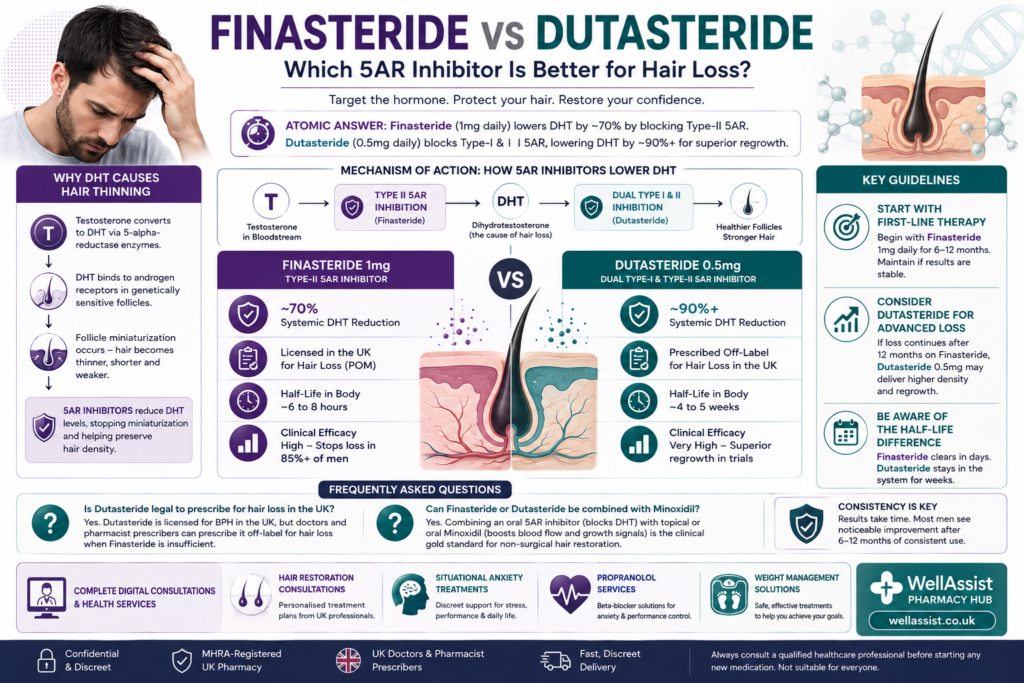
Finasteride (1mg daily) is a selective Type-II 5-alpha-reductase inhibitor that lowers circulating DHT by approximately 70%, making it the first-line UK standard for male pattern baldness. Dutasteride (0.5mg daily) is a dual Type-I and Type-II 5AR inhibitor that lowers DHT levels by over 90%, offering superior hair regrowth and scalp coverage for men who show an incomplete response to Finasteride.
Mechanism of Action: Type I vs. Type II 5AR Enzymes
                   ┌─────────────────────────────────────────┐
                   │    Testosterone in Bloodstream          │
                   └────────────────────┬────────────────────┘
                                        │
             ┌──────────────────────────┴──────────────────────────┐
             ▼ TYPE II 5AR INHIBITION                              ▼ DUAL TYPE I & II INHIBITION
┌─────────────────────────┐                           ┌─────────────────────────┐
│ Finasteride (1mg)       │                           │ Dutasteride (0.5mg)     │
│ Targets Type II Enzyme  │                           │ Targets Types I & II    │
└────────────┬────────────┘                           └────────────┬────────────┘
             │                                                     │
             ▼                                                     ▼
┌─────────────────────────┐                           ┌─────────────────────────┐
│ ~70% Serum DHT          │                           │ ~90%+ Serum DHT         │
│ Reduction               │                           │ Reduction               │
└────────────┬────────────┘                           └────────────┬────────────┘
             │                                                     │
             ▼                                                     ▼
┌─────────────────────────┐                           ┌─────────────────────────┐
│ Slows Loss & Preserves  │                           │ Maximum Follicle        │
│ Existing Scalp Density  │                           │ Reversal & Density      │
└─────────────────────────┘                           └─────────────────────────┘
1. Why DHT Causes Hair Thinning
Genetically sensitive hair follicles on the crown and hairline contain androgen receptors. When testosterone converts into dihydrotestosterone (DHT) via 5-alpha-reductase enzymes, it binds to these receptors, causing follicle miniaturization—making hair strands progressively thinner, shorter, and eventually unable to penetrate the scalp.
2. Single vs. Dual Isoenzyme Blocking
Dutasteride: Blocks both Type-I (found in sebaceous glands and skin) and Type-II isoenzymes. Because it blocks Type-I as well, it shuts down almost all systemic DHT production.
Finasteride: Specifically targets the Type-II 5AR isoenzyme, which predominates in scalp hair follicles and the prostate.
Head-to-Head Comparison: Finasteride vs. Dutasteride
| Feature | Finasteride 1mg | Dutasteride 0.5mg | Top Page Link |
| Enzyme Inhibition | Type-II 5-alpha-reductase | Dual Type-I & Type-II 5AR | WellAssist Pharmacy Hub |
| Systemic DHT Reduction | ~70% | ~90%+ | WellAssist Hub |
| Licensing in the UK | Licensed for Hair Loss (POM) | Prescribed Off-Label for Hair Loss | Situational Anxiety |
| Half-Life in Body | ~6 to 8 hours | ~4 to 5 weeks | Propranolol Services |
| Clinical Efficacy | High (stops loss in 85%+ of men) | Very High (superior regrowth in trials) | Weight Management |
Key Guidelines for UK Hair Loss Management
- Start with First-Line Therapy: Most prescribers recommend starting with Finasteride 1mg daily for at least 6 to 12 months. If hair thinning stabilizes, maintaining Finasteride is often sufficient.
- Consider Dutasteride for Advanced Loss: If hair loss continues after 12 months on Finasteride, transitioning to Dutasteride 0.5mg under clinical guidance can yield higher hair counts and thicker regrowth.
- Be Aware of the Half-Life Difference: Finasteride clears the system within days of stopping. Due to Dutasteride’s long half-life (several weeks), its DHT-suppressing effects remain in the bloodstream much longer after treatment is discontinued.
Yes. While Dutasteride is officially licensed in the UK for Benign Prostatic Hyperplasia (BPH), registered UK doctors and pharmacist prescribers can prescribe it off-label for androgenetic alopecia when first-line options like Finasteride are insufficient.
Yes. Combining an oral 5AR inhibitor (which stops hormonal miniaturization) with topical or oral Minoxidil (which increases blood flow and growth signals to follicles) is widely considered the clinical gold standard for non-surgical hair restoration.