
Among the most heavily searched, trending, and viral queries across UK medical search engines is “Mounjaro sulfur burps,” “how to stop GLP-1 foul gas,” and “why do my burps smell like rotten eggs on Wegovy?“ While appetite suppression and metabolic transformation are welcome benefits, sudden, foul-smelling gastrointestinal side effects can cause severe social embarrassment and distress for patients.
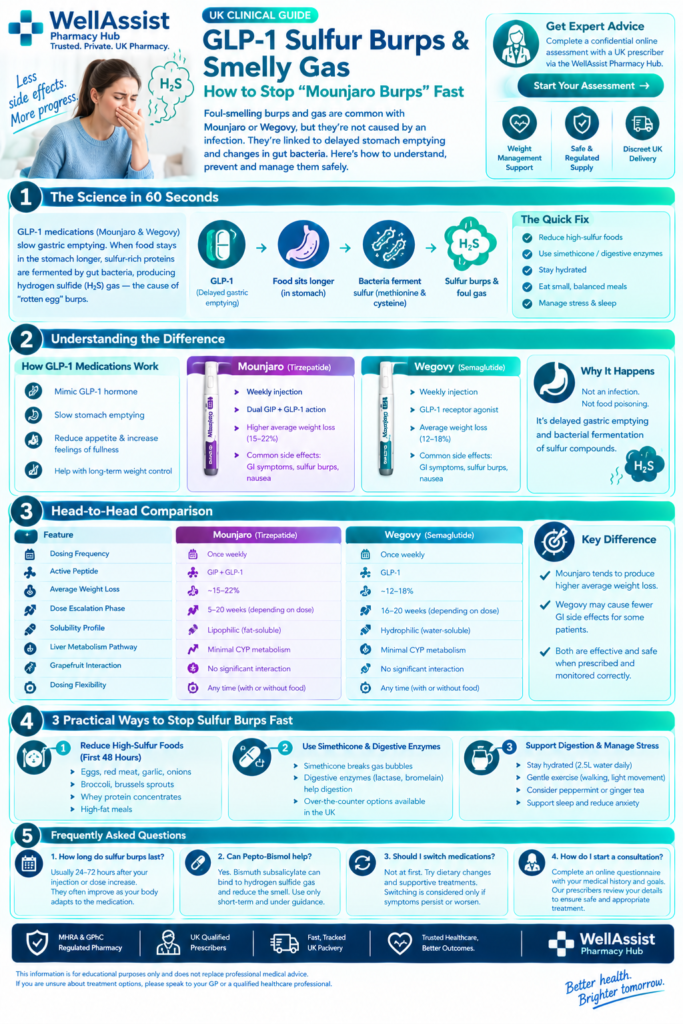
These unpleasant, sulfurous eructations are not caused by an infection or food poisoning, but by delayed gastric emptying (gastroparesis-like slowing). When food sits in the stomach for an extended period, natural gut bacteria ferment sulfur-rich proteins, producing hydrogen sulfide ($\text{H}_2\text{S}$) gas.
Whether you are navigating dose titration or managing new digestive side effects, complete a private assessment on the WellAssist Pharmacy Hub or browse our primary clinical services:
The Science in 60 Seconds
GLP-1 sulfur burps occur because medications like Mounjaro and Wegovy significantly delay gastric emptying, slowing down stomach motility. When high-sulfur foods (such as eggs, red meat, cruciferous vegetables, or dairy) remain in the warm, acidic stomach environment for too long, anaerobic bacteria ferment methionine and cysteine amino acids, releasing hydrogen sulfide ($\text{H}_2\text{S}$) gas—the compound responsible for the “rotten egg” smell. To stop GLP-1 sulfur burps fast, UK clinicians recommend reducing dietary sulfur and fat intake, taking simethicone or digestive enzymes, drinking peppermint or ginger tea, and remaining upright for at least 2 hours after meals.
Mechanism Breakdown: Gastric Slowing vs. Gas Neutralization
                   ┌─────────────────────────────────────────┐
                   │    GLP-1 Delayed Gastric Emptying      │
                   └────────────────────┬────────────────────┘
                                        │
             ┌──────────────────────────┴──────────────────────────┐
             ▼ UNMANAGED DIETARY SULPHUR                           ▼ CLINICAL DIGESTIVE PROTOCOL
┌─────────────────────────┐                           ┌─────────────────────────┐
│ High Sulfur & Heavy Fat │                           │ Low-Sulfur, Lean Food   │
│ Foods Sit in Stomach    │                           │ Portions + Simethicone  │
└────────────┬────────────┘                           └────────────┬────────────┘
             │                                                     │
             ▼                                                     ▼
┌─────────────────────────┐                           ┌─────────────────────────┐
│ Bacterial Fermentation  │                           │ Accelerated Gastric     │
│ Releases H2S Gas        │                           │ Processing & Low Gas    │
└────────────┬────────────┘                           └────────────┬────────────┘
             │                                                     │
             ▼                                                     ▼
┌─────────────────────────┐                           ┌─────────────────────────┐
│ Rotten Egg Sulfur Burps │                           │ Neutral, Odourless      │
│ & Abdominal Bloating    │                           │ Digestion & Satiety     │
└─────────────────────────┘                           └─────────────────────────┘
1. Why Delayed Emptying Triggers Hydrogen Sulfide Gas
Incretin therapies work by keeping food in the stomach longer to prolong fullness. However, when sulfur-containing compounds (methionine and cysteine) remain trapped in the stomach alongside gastric acid, intestinal microbes break them down into volatile gas, which escapes upward as sulfur burps.
2. Why High-Fat Meals Worsen Gastric Fermentation
Dietary fats naturally slow stomach emptying even further. Combining a high-fat meal with a GLP-1 medication creates a “double-delay,” maximizing bacterial fermentation and causing foul gas, bloating, and acid reflux.
Clinical Management Comparison: GLP-1 Side Effects & Digestive Health
| Side Effect / Topic | Root Cause | Primary Clinical Protocol | Relevant Site / Guide Link |
| GLP-1 Sulfur Burps | Extended gastric transit & $\text{H}_2\text{S}$ gas | Simethicone, low-sulfur diet & digestive tea | Weight Management Solutions |
| Bowel Motility Shifts | Slower colonic transit / bile surges | Soluble fiber, hydration & low-fat diets | GLP-1 Constipation vs Diarrhoea Guide |
| GLP-1 Fatigue & Energy | Glycogen depletion & electrolyte loss | Electrolytes, complex carbs & protein | GLP-1 Fatigue & Energy Drops Guide |
| Post-GLP-1 Weight Regain | Ghrelin hormone surge post-treatment | Step-down tapering & protein focus | Stopping Mounjaro Regain Guide |
| Sarcopenia & Muscle Loss | Protein deficit & reduced metabolism | 1.2–1.6g/kg protein + lifting | GLP-1 Sarcopenia & Muscle Loss Guide |
| “Ozempic Face” & Skin | Rapid fat & collagen depletion | Gradual pace (0.5–1kg/wk) + collagen | Ozempic Face Prevention Guide |
| Workplace Stress & Panic | Adrenaline surge on beta receptors | Non-sedating beta-blocker care | Propranolol Services |
3 Practical Guidelines to Stop Sulfur Burps Fast
- Temporarily Reduce High-Sulfur Foods: During the first 48 hours after your weekly injection or dose escalation, limit heavy sulfur sources such as eggs, red meat, garlic, onions, broccoli, brussels sprouts, and whey protein concentrates.
- Utilize Simethicone and Digestive Enzymes: Over-the-counter simethicone helps break gas bubbles into smaller units for easier passage, while digestive enzymes (like lactase or bromelain) assist in breaking down food before fermentation occurs.
- Manage Stress and Digestive Motility: High workplace anxiety and stress alter gut motility via the vagus nerve, worsening stomach stagnation. Supporting your autonomic nervous system with Propranolol Services or Situational Anxiety Treatments helps promote steady digestion.
Frequently Asked Questions
Sulfur burps are most common during the first 24 to 72 hours following a weekly injection or after stepping up to a higher dose strength. As your digestive system adapts to the medication and you adjust your diet, sulfur burps usually subside.
Yes. Bismuth subsalicylate binds directly to hydrogen sulfide gas in the stomach, neutralizing the rotten egg odor quickly. However, it should only be used short-term under prescriber or pharmacist guidance.